AI coding plans in 2026 use very different billing models. Some provide a fixed monthly token or credit allowance, some refresh usage quotas every few hours or each week, and others continue serving requests at reduced priority after a high-speed allowance is exhausted.
The best plan, therefore depends on how you work. MiniMax is a strong option for developers who want a broad model and multimodal subscription. Xiaomi MiMo offers a low-cost entry point and large credit packages for supported coding tools. GLM Coding Plan suits developers committed to the GLM ecosystem. Kimi Code offers a first-party CLI and IDE workflow. Canopy Wave is designed for developers who want predictable monthly API costs for sustained agent and coding workloads.
This guide compares their pricing models, limits, integrations, and best-fit use cases. Prices and plan details were checked on July 17, 2026; providers may change regional pricing, promotions, models, and usage policies.
AI Coding Plans at a Glance
| Plan | Starting price | Usage model | Notable models or experience | Best for |
|---|---|---|---|---|
| MiniMax Token Plan | $20/month | Monthly token allowance | MiniMax M3 and MiniMax Code | Developers wanting coding plus multimodal features |
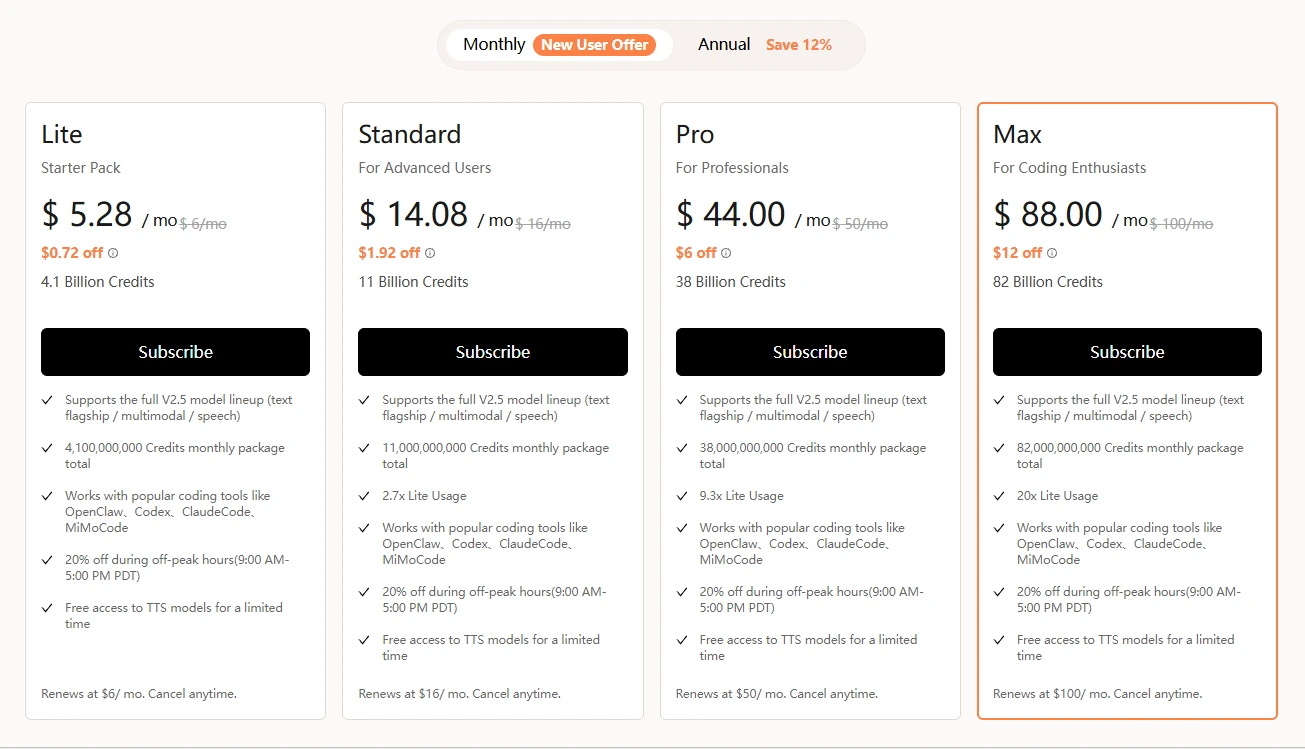
| Xiaomi MiMo Token Plan | $6/month | Monthly credits | MiMo-V2.5 series | Low-cost entry and long-context coding tools |
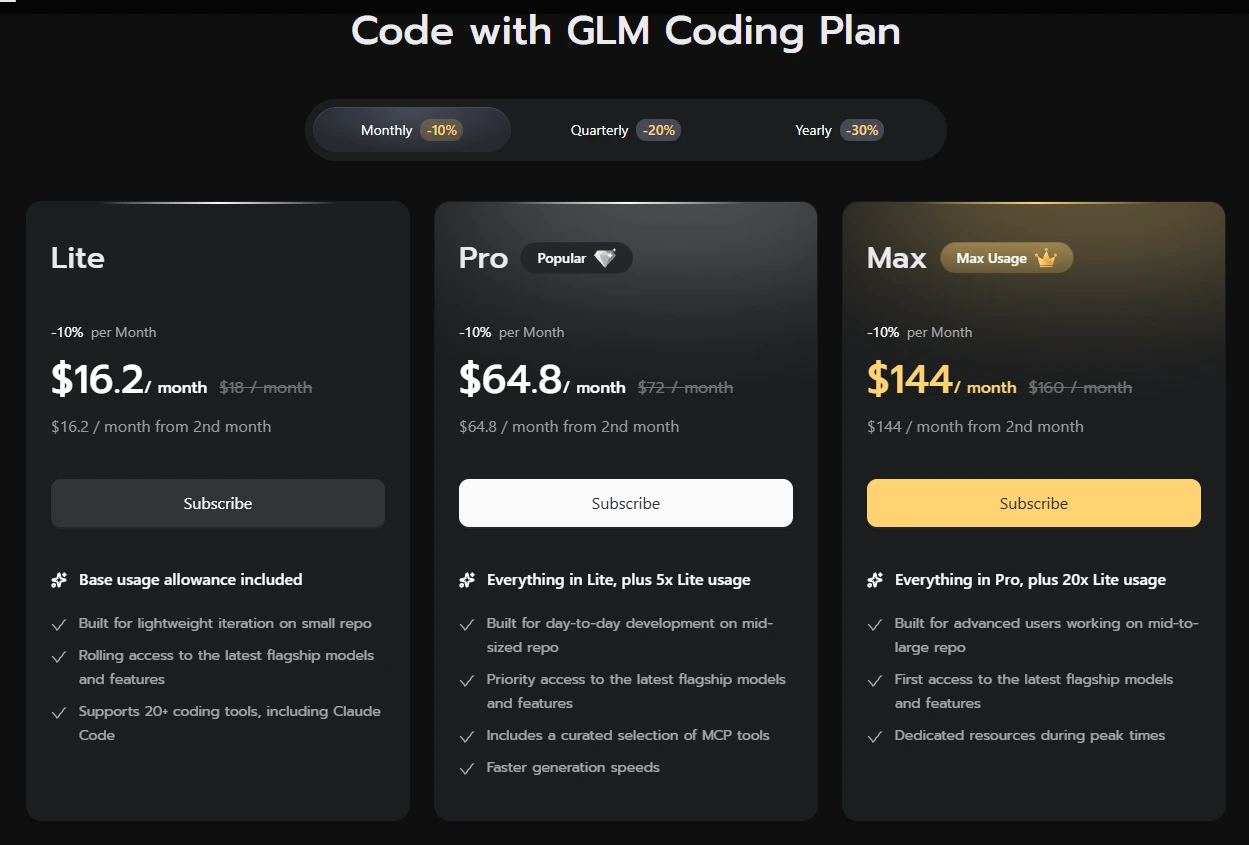
| GLM Coding Plan | Check regional pricing | Five-hour and weekly prompt quotas | GLM-5.2, GLM-5-Turbo, GLM-4.7 | Developers using the GLM coding ecosystem |
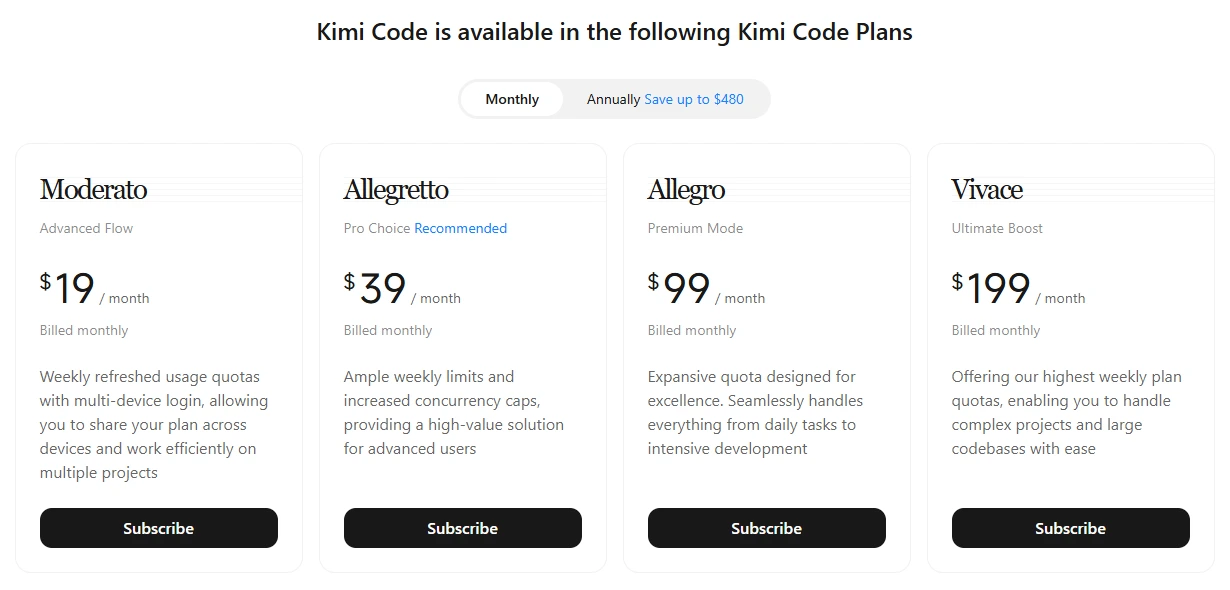
| Kimi Code | Check regional pricing | Separate Kimi Code credit pool and plan limits | Kimi Code CLI and IDE experience | Developers wanting a first-party coding agent |
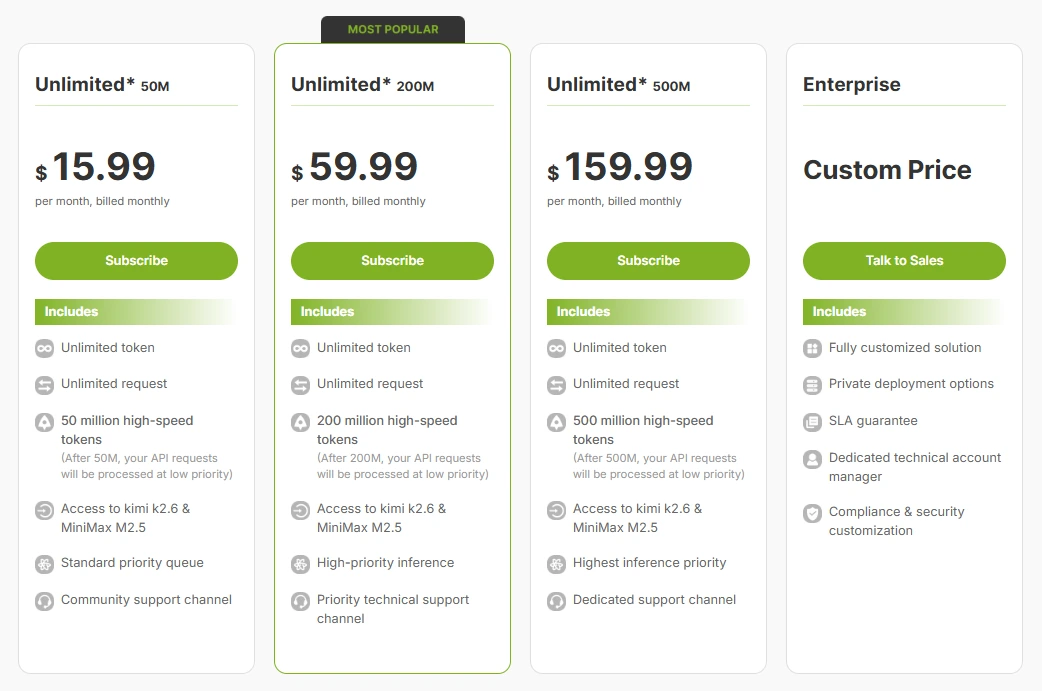
| Canopy Wave Unlimited Token Plan | $15.99/month | High-speed monthly tokens, then reduced-priority access | Kimi K2.6 and MiniMax M2.5 | Sustained OpenAI-compatible API and agent workloads |
Pricing alone does not show the full picture. A credit is not always equal to a token, a prompt may trigger many model calls, and an "unlimited" plan may reduce throughput after a high-speed allowance. Always compare the usage policy with your actual workflow.
What to Look for in an AI Coding Subscription
Before subscribing, evaluate six factors.
1. Billing model:
Token plans are easy to measure but can be consumed quickly by repository context and agent tool calls. Credit plans may apply different conversion rates depending on the model. Prompt-based plans are easier to understand at first, although one prompt may trigger many underlying model calls.
2. Refresh period and fair-use limits:
Check whether usage resets monthly, weekly, every five hours, or on a rolling basis. Also verify what happens when the allowance is exhausted: requests may stop, wait for the next reset, move to a lower-priority queue, or incur additional charges.
3. Model quality for your workload:
The best model for autocomplete may not be the best model for repository-wide refactoring or autonomous agents. Test the plan against your own languages, frameworks, test suite, and codebase size.
4. Context handling:
Large context windows help with complex repositories, but advertised context length is not the same as affordable usable context. Repeatedly sending a large repository can consume allowances quickly, especially when cache pricing or credit conversion is unfavorable.
5. Tool compatibility:
Confirm support for the tools you actually use, such as Claude Code, OpenCode, OpenClaw, Cline, Roo Code, Kilo Code, terminal agents, or an OpenAI-compatible client. Some subscriptions only permit usage inside approved coding tools and do not cover general backend API workloads.
6. Cost predictability:
For occasional coding, pay-as-you-go API pricing may cost less. For daily agents, long refactoring sessions, or overnight tasks, a fixed subscription may make budgeting easier.
1. MiniMax Token Plan: Best for Coding Plus Multimodal Work
MiniMax Code works directly with the subscription, while developers can also connect supported third-party tools using a compatible key. This makes the plan useful for people who want one subscription for coding, text, image, speech, music, and other supported workflows.
Best for:
1. Daily software development
2. Multiple concurrent coding agents
3. Developers who also need multimodal generation
4. Medium to large codebases
Key considerations:
1. The allowance is still finite, even when it is large.
2. Coding and other supported modalities may share the same quota.
3. Heavy agent loops can consume substantially more context than simple chat requests.
Token Plan - MiniMax API Platform
2. Xiaomi MiMo Token Plan: Best Low-Cost Entry Option
MiMo supports popular coding environments including OpenClaw, OpenCode, Kilo Code, Cline, and other approved tools. Its long-context models make it relevant for repository analysis and agent workflows.
Best for:
1. Developers testing AI coding subscriptions for the first time
2. Long-context coding tasks
3. Supported agent and IDE workflows
4. Users who prefer a credit-based monthly budget
Key considerations:
1. Credit consumption varies by model and usage pattern.
2. The Token Plan is intended for supported coding tools; it is not a general-purpose backend API package.
3. Large cached contexts and repeated tool calls can materially affect real usage, so run a representative test before choosing a tier.
3. GLM Coding Plan: Best for the GLM Ecosystem
Rather than offering a single monthly token balance, GLM applies rolling five-hour limits and weekly prompt limits. The official documentation currently estimates up to 80, 400, or 1,600 prompts per five-hour window for Lite, Pro, and Max, with corresponding weekly estimates of 400, 2,000, and 8,000 prompts. Actual usage depends on project complexity and model multipliers.
Best for:
1. Professional coding with GLM models
2. Developers who prefer rolling quota refreshes
3. Teams using supported Chinese and international coding tools
4. Workflows that benefit from GLM's integrated MCP capabilities
Key considerations:
1. The plan only applies in officially supported tools and environments.
2. Advanced models can consume quota at higher multipliers during specified periods.
3. After the quota is exhausted, users generally wait for the relevant reset rather than automatically consuming pay-as-you-go balance.
4. Kimi Code: Best First-Party CLI and IDE Experience
Kimi Code is designed for writing, debugging, refactoring, codebase exploration, command execution, and web research within a first-party workflow.
Best for:
1. Developers who want an official coding CLI
2. Terminal and IDE workflows
3. Daily project maintenance
4. Users already paying for Kimi membership benefits
Key considerations:
1. Available models and plan quotas can change as Kimi updates its coding product.
2. Higher tiers generally provide larger weekly limits and concurrency allowances.
3. Check the current membership page for pricing and regional availability before publishing a fixed price.
5. Canopy Wave Unlimited Token Plan: Best for Predictable High-Volume API Use
The plan currently offers three monthly tiers:
| Tier | Monthly price | High-speed token allowance | After the allowance |
|---|---|---|---|
| Unlimited 50M | $15.99 | 50 million tokens | Requests continue under reduced-priority fair-use limits |
| Unlimited 200M | $59.99 | 200 million tokens | Requests continue under reduced-priority fair-use limits |
| Unlimited 500M | $159.99 | 500 million tokens | Requests continue under reduced-priority fair-use limits |
The plans currently provide access to Kimi K2.6 and MiniMax M2.5. The main advantage is predictable billing for developers who run sustained coding sessions, large refactors, or autonomous agents without wanting pay-as-you-go charges to accumulate unpredictably.
Best for:
• Long-running coding and autonomous agent sessions
• Developers who need an OpenAI-compatible endpoint
• High-volume personal or development workflows
• Users prioritizing predictable monthly API costs
Key considerations:
• Production systems requiring guaranteed high concurrency should use an appropriate standard or enterprise plan.
• Compare expected monthly context usage with the 50M, 200M, and 500M high-speed tiers.
• Current model availability should be checked before subscribing.
Which AI Coding Plan Offers the Best Value in 2026?
There is no universal winner because each plan optimizes for a different usage pattern.
• Choose MiniMax if you want coding, multiple agents, and multimodal tools under one subscription.
• Choose Xiaomi MiMo if you want the lowest entry price and primarily work in supported coding tools.
• Choose GLM Coding Plan if you prefer GLM models and rolling prompt quotas.
• Choose Kimi Code if you want a polished first-party terminal and IDE coding experience.
• Choose Canopy Wave if you need predictable high-volume access through an OpenAI-compatible API and understand the reduced-priority policy after the high-speed allowance.
For light or irregular use, compare these subscriptions with pay-as-you-go API pricing before committing. For heavy use, test each provider with the same real repository and measure task completion, latency, context consumption, tool-call reliability, and total monthly cost.
A Practical Testing Checklist
Before purchasing an annual plan, run the same five tasks on your shortlisted services:
1. Ask the model to explain an unfamiliar part of a real repository.
2. Implement a feature that touches several files.
3. Run tests, diagnose a failure, and revise the code.
4. Refactor a large module without changing behavior.
5. Leave an agent running on a multi-step task and measure completion rate and allowance consumed.
Record time to first response, total completion time, accepted code percentage, number of retries, tokens or credits consumed, and whether the model followed repository instructions. These measurements are more useful than a benchmark score alone.
Frequently Asked Questions
An AI coding token plan is a subscription that provides a monthly allowance for model input, output, or both. Some providers call the allowance credits rather than tokens and apply different conversion rates by model.
It depends on the policy. Some plans continue accepting requests after a high-speed allowance is exhausted but reduce priority, throughput, or concurrency. Always read the fair-use and rate-limit documentation.
Token plans provide granular usage visibility. Prompt-based plans are easier to understand but can hide how many model calls happen behind each prompt. The better choice depends on whether your workload uses short interactions or long agent loops.
Look for a large allowance, predictable billing, reliable tool calling, sufficient context, and compatibility with your agent. Canopy Wave, MiniMax, MiMo, GLM, and Kimi all support agent-oriented workflows in different ways, but their quota and tool restrictions differ.
Not always. Some coding subscriptions are restricted to approved developer tools. If you are building a customer-facing application, verify that the provider permits backend API use and offers suitable rate limits, service terms, and support.
Final Recommendation
The best AI coding plan is the one that completes your real development tasks reliably at a predictable total cost. Start with a monthly tier, test it against your own repository, and avoid choosing solely by the largest advertised token or credit number.