In today's rapidly developing field of artificial intelligence, with the rapid popularization of large language models, these models have become a key tool for corporate innovation and personal projects. Developers are increasingly demanding high-performance, low-cost, and easily integrated AI APIs. Against this backdrop, DeepSeek, a leading AI research company in China, is rapidly becoming the preferred solution for developers, and the DeepSeek API has become a focus of attention for developers, startups, and enterprise users. This article will delve into the core functions, application scenarios, technical advantages, and how to efficiently integrate the DeepSeek API into your projects.
What is the DeepSeek API?
The DeepSeek API is a set of large language model (LLM) interface services provided by DeepSeek, allowing developers to access its advanced natural language processing models via HTTP API. Simply put, the DeepSeek API is equivalent to the programmable capabilities of the DeepSeek large language model, similar to OpenAI's GPT series. The DeepSeek API provides functions such as text generation, conversational chatbots, code writing, data analysis and reasoning, text analysis, search enhancement (RAG), and multilingual translation, but it demonstrates unique advantages in Chinese language processing, cost-effectiveness, and technical support.
Core Features of the DeepSeek API
1. Powerful Reasoning and Coding Capabilities
DeepSeek excels in reasoning and code understanding, particularly in tasks such as mathematical and logical reasoning, complex instruction following, code generation, refactoring, explanation, and multi-step problem decomposition.
2. Multimodal Processing Capabilities
While DeepSeek is known for its text processing capabilities, its API supports complex multimodal tasks, including image content analysis (via text descriptions) and document processing, meeting diverse application needs.
3. Flexible Pricing Strategy
Compared to mainstream APIs like OpenAI and Anthropic, the DeepSeek API offers a more competitive pricing structure, especially suitable for small and medium-sized enterprises and individual developers. The pay-as-you-go model and tiered pricing ensure cost control.
4. Low Latency and High Concurrency
Infrastructure optimized for the international market ensures low latency for API calls, maintaining stable response speeds even in high-concurrency scenarios.
5. Comprehensive Developer Support
The DeepSeek API provides detailed documentation, SDKs (supporting multiple languages such as Python and JavaScript), sample code, and an active technical community, significantly reducing integration difficulty. Support for standard RESTful calls and streaming output greatly reduces migration and learning costs.
DeepSeek API's Main Functional Modules
1. Dialogue and Text Generation Module
The DeepSeek API's dialogue and text generation module is one of its core and most widely used capabilities. This module supports multi-turn conversations and can understand user intent in a continuous context, making it ideal for building intelligent systems with long-term memory and contextual understanding. In terms of content creation, DeepSeek API can generate high-quality blog posts, marketing copy, product descriptions, and technical documentation, significantly improving content production efficiency. Simultaneously, in intelligent question-answering scenarios, DeepSeek API can semantically understand and integrate information from user questions, outputting clear and concise answers. With these capabilities, this module is widely used in chatbots, content platforms, and customer service systems, providing users with a more natural, efficient, and intelligent interactive experience.
2. Reasoning and Analysis Module
The reasoning and analysis module is one of DeepSeek API's most prominent core strengths. This module excels at systematically breaking down complex problems, decomposing seemingly chaotic or highly abstract tasks into multiple executable sub-steps, thereby significantly improving the accuracy and interpretability of the results. In terms of mathematical and logical reasoning, the DeepSeek math API has strong capabilities in formula calculation, conditional judgment, causal relationship analysis, and multi-constraint problems. Furthermore, DeepSeek API supports multi-step decision support, integrating various input information during continuous reasoning to gradually provide optimal or feasible solutions. This reasoning and analysis module makes DeepSeek API particularly suitable for advanced application scenarios such as data analysis, intelligent decision systems, AI agents, and complex business process automation.
3. Code Generation and Understanding Module
DeepSeek excels in code generation, supporting dozens of programming languages including Python, Java, JavaScript, and C++. It is proficient in generating code from natural language descriptions, code completion, code review and optimization suggestions, bug debugging and fixing, and code comment generation, making it ideal for AI programming assistants and developer tools.
How to Use the DeepSeek API
Step 1: Obtain an API Key
1. Visit the DeepSeek official website and register an account.
2. Access the developer console.
3. Create a new project and obtain your API key.
4. Choose a suitable plan (free trial, pay-as-you-go, or enterprise plan).
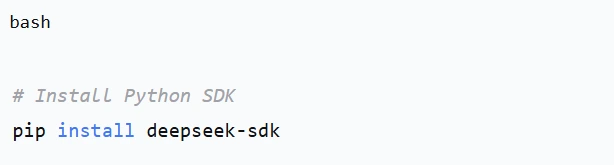
Step 2: Install and Configure the SDK
You can install the OpenAI SDK (compatible with DeepSeek) via pip:
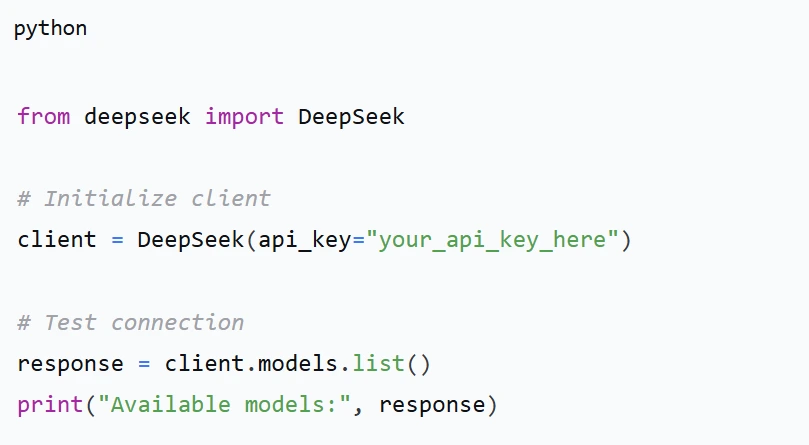
Step 3: Implement basic integration
DeepSeek API Best Practices
1. Effectively manage API calls
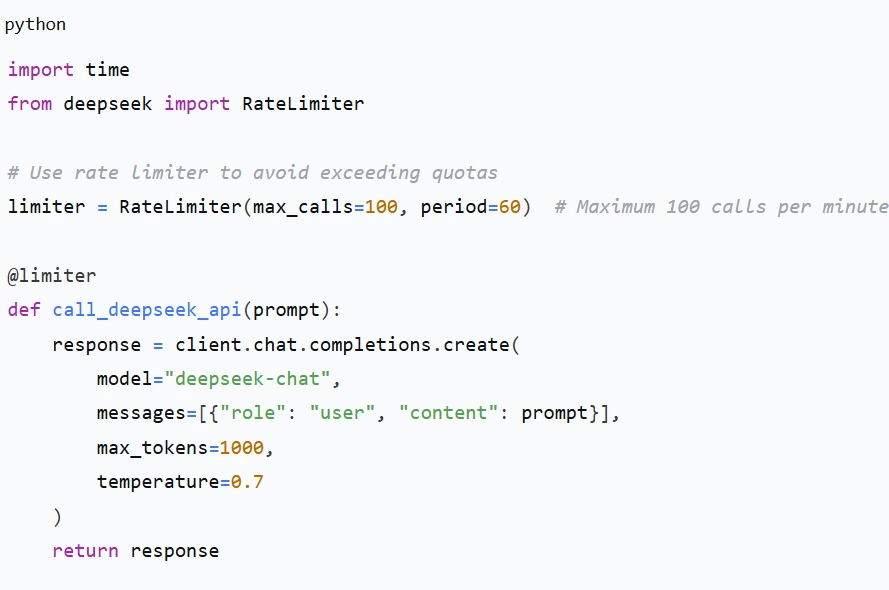
To ensure stability and cost-effectiveness, it is recommended to implement rate limiting and caching strategies.
2. Optimizing Prompt
• Be clear and specific: Provide clear and specific instructions.
• Context management: Maintain conversational coherence.
• System prompts: Set the AI's role and behavioral parameters.
• Iterative optimization: Adjust prompts based on the results.
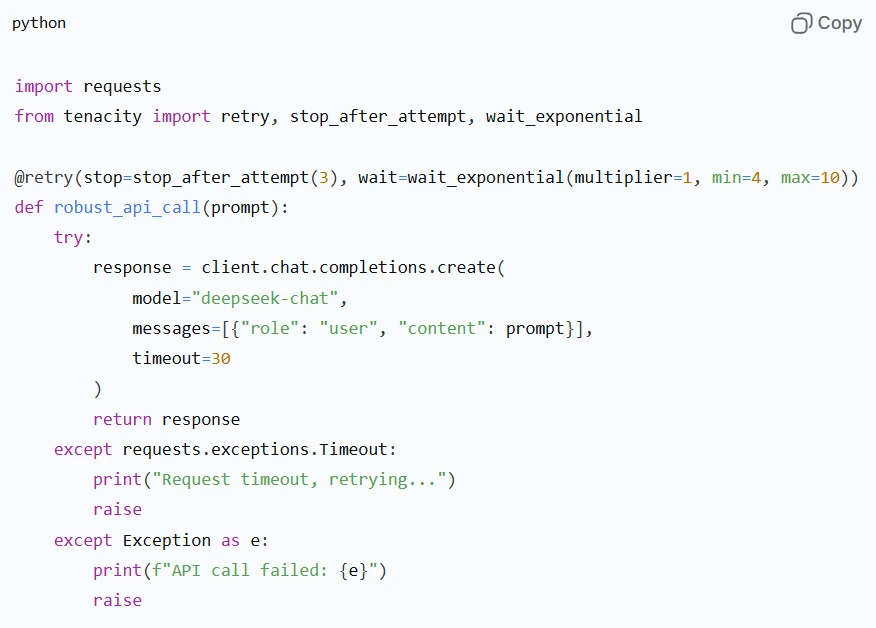
3. Error handling and retry mechanisms
Always implement robust error handling to manage network issues or API limits gracefully.
Application Cases of DeepSeek API
Case 1: Intelligent Customer Service System
An e-commerce company used the DeepSeek API to build a 24/7 intelligent customer service system, handling 80% of common inquiries, reducing the workload of human customer service by 60%, and increasing customer satisfaction by 25%.
Case 2: Content Creation Platform
A new media company integrated the DeepSeek API to develop an automatic content generation tool, which can automatically generate high-quality article outlines, paragraph content, and even complete articles based on keywords, increasing production efficiency by 300%.
Case 3: Educational Technology Application
An online education platform utilized the DeepSeek API to create a personalized learning assistant, which provides customized answers, practice questions, and learning suggestions based on students' learning progress and questions.
Case 4: Code Development Assistant
A software development team integrated the DeepSeek API into their IDE, enabling intelligent code completion, error detection, and documentation generation, increasing development efficiency by 40%.
DeepSeek API vs Other Major LLM APIs
| Comparison Dimension | DeepSeek API | OpenAI API | Anthropic API | Gemini API |
|---|---|---|---|---|
| Cost Efficiency | ⭐⭐⭐⭐⭐ | ⭐⭐⭐ | ⭐⭐⭐ | ⭐⭐⭐⭐ |
| Reasoning Capability | ⭐⭐⭐⭐⭐ | ⭐⭐⭐⭐ | ⭐⭐⭐⭐ | ⭐⭐⭐⭐ |
| Code Generation Ability | ⭐⭐⭐⭐⭐ | ⭐⭐⭐⭐ | ⭐⭐⭐ | ⭐⭐⭐⭐ |
| Response Speed | ⭐⭐⭐⭐ | ⭐⭐⭐⭐⭐ | ⭐⭐⭐⭐ | ⭐⭐⭐⭐⭐ |
| API Ease of Use | ⭐⭐⭐⭐ | ⭐⭐⭐⭐⭐ | ⭐⭐⭐⭐ | ⭐⭐⭐⭐ |
| Documentation Quality | ⭐⭐⭐⭐ | ⭐⭐⭐⭐⭐ | ⭐⭐⭐⭐ | ⭐⭐⭐⭐⭐ |
| Scalability for Production | ⭐⭐⭐⭐⭐ | ⭐⭐⭐⭐ | ⭐⭐⭐ | ⭐⭐⭐⭐ |
Future Development of DeepSeek API
1. Enhanced Multimodal Capabilities
From the overall technological evolution trend, the future development of DeepSeek API will continue to focus on multimodal capabilities. In upcoming features, image generation integration will be a significant addition. DeepSeek API is expected to combine text-to-image capabilities, allowing developers to complete both text generation and visual content creation within the same API system, further expanding content generation and creative application scenarios. Meanwhile, voice interaction support will also be a key direction. By introducing text-to-speech (TTS) and automatic speech recognition (ASR) capabilities, DeepSeek API will be able to support a more natural human-computer interaction experience, suitable for voice assistants, intelligent customer service, and multimodal interaction systems.
2. Enterprise-Level and Industry-Specific Models
In terms of collaboration and productivity, DeepSeek API may also support real-time collaboration features in the future, allowing multiple users to simultaneously edit content and receive AI-assisted suggestions. This will provide more efficient intelligent support for online documents, code collaboration platforms, and team knowledge management systems. Furthermore, with the growth of enterprise-level demands, vertical industry models will become one of the important development directions for DeepSeek API. By providing specialized training and optimization for industries such as finance, healthcare, and law, DeepSeek API is expected to offer more targeted solutions in terms of compliance, professional terminology understanding, and industry-specific reasoning capabilities.
3. Technical Roadmap
From a technical roadmap perspective, the core model capabilities of DeepSeek API will also continue to evolve. Future versions are expected to further expand the model parameter scale to improve knowledge coverage and complex task processing capabilities; at the same time, a further increase in context length will significantly enhance its performance in long document understanding, RAG architecture, and complex multi-turn conversations. Based on this, the continuous enhancement of reasoning capabilities will make DeepSeek API more stable and reliable in multi-step analysis, decision support, and AI Agent scenarios.
Conclusion: Why choose DeepSeek API?
From functional depth and cost-effectiveness to future potential, DeepSeek API is becoming a key choice for next-generation large language model APIs. Whether you are a startup looking for cost-effective AI integration solutions or a large enterprise requiring customized, large-scale AI deployments, DeepSeek API can provide flexible, reliable, and efficient solutions. As AI technology continues to evolve, DeepSeek API will continue to innovate, providing developers with more powerful tools and jointly promoting the popularization and application of artificial intelligence technology.
Popular DeepSeek API Models Available on Canopy Wave
Canopy Wave currently supports and features several popular DeepSeek models, covering various use cases such as general conversation, complex reasoning, mathematical computation, and efficient inference, allowing users to flexibly choose based on their actual needs.
DeepSeek-V3.2 API
DeepSeek-V3.2 is a very popular general-purpose large language model version, excelling in text generation, complex reasoning, and long-context understanding. It is suitable for applications such as chatbots, content generation platforms, and multi-step AI agents. This model achieves a good balance between performance and stability, making it suitable for direct use in production environments.
DeepSeek-Math-V2 API
DeepSeek-Math-V2 focuses on mathematical and logical reasoning capabilities, making it ideal for educational products, research assistance tools, and technical applications requiring high-precision computing capabilities.
DeepSeek-V3.1 API
DeepSeek-V3.1 is a general-purpose model version that balances efficiency and reasoning capabilities. It can complete complex analysis, code generation, and multi-turn dialogue tasks with lower resource consumption, making it suitable for business scenarios that require both cost-effectiveness and performance.
DeepSeek-R1-Distill Qwen-32B API
This model is based on the R1 inference series and has undergone distillation optimization. While maintaining strong reasoning capabilities, it reduces the model size, making it more suitable for applications sensitive to response speed and resource consumption, such as high-concurrency inference services and lightweight intelligent systems.