Jensen Huang commented on OpenClaw at NVIDIA GTC 2026. "OpenCLaw is the number one and the most popular open source project in the history of humanity, and it did so in just a few weeks. It exceeded what Linux did in 30 years, and it's that important."
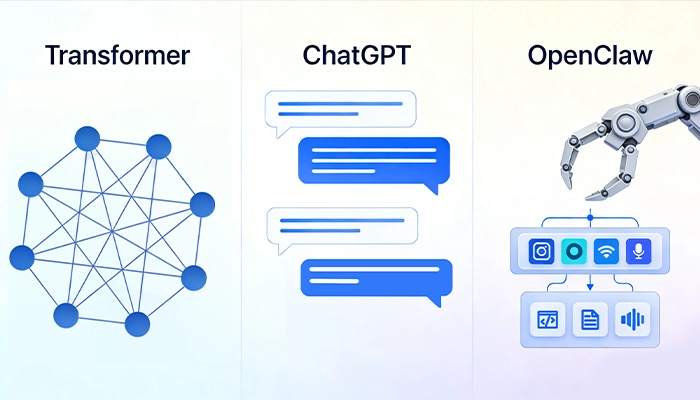
Transformer
The Transformer paper published in 2017 was the first disruption of this new wave of AI. This paper made powerful models possible.
Then it took five years of layered innovations to make something like ChatGPT practical, safe, and widely adopted:
• 2017 - Transformer, "Attention Is All You Need"
• 2018 - Pre-training breakthrough, breaking one model into pre-training and fine-tuning
• 2018 to 2019 - Text generation emerges, GPT emerges with strong natural language model generation
• 2020 - Scaling leap, GPT-3, scale unlocks new capabilities
• 2021 - Alignment, Reinforcement Learning from Human Feedback
ChatGPT
ChatGPT was the second milestone of this new AI.
Before ChatGPT, powerful models like GPT-3 were mostly accessible through APIs and required technical skills. ChatGPT turned that capability into a simple chat interface, with no coding required, giving instant interaction, and using natural language as the interface.
This dramatically lowered the barrier to entry. Millions of people could suddenly use AI, not just build with it. Earlier chatbots were rigid and rule-based. ChatGPT showed that conversation itself can be a powerful UI:
• Multi-turn context handling
• Flexible responses instead of scripted ones
• Ability to clarify, refine, and iterate
This influenced product design across industries, including search, customer support, coding tools, and more. From 2022 to 2023, ChatGPT as a leading human-machine interface, it enables multiple applications:
• 2022 - ChatGPT, turns AI into a mass-use product
• 2023 - GPT-3, with reasoning capability, and LLaMA, first Open-source LLM
• 2024 - GPT-4, multimodal AI and the emerged coding assistants
• 2025 - Agent systems that plans and acts
OpenClaw
ChatGPT is basically a mass-adopted interface for intelligence. It changed how humans interact with machines. However, it is limited at conversation TO HUMAN.
In January, 2026, OpenClaw changed that. OpenClaw is important because it moves AI from answering questions to doing actual work on a computer.
OpenClaw agent represents a shift from text generation to real-world actions. Unlike ChatGPT, it can operate software (click, type, navigate). It treats the computer as a universal interface, not just APIs or Chat. OpenClaw introduces autonomous agents that plan and execute tasks.
OpenClaw is important because it moves AI from answering questions to doing actual work on a computer.
What is Next
What's next after OpenClaw-style agents? Well, more agents and better agents.
In a short list, we are getting into another 3-4 years of Agent revolution:
• Reliability, agents that consistently complete tasks end-to-end
• Multi-agent teamwork, multiple AIs collaborating on complex workflows
• Deep integration, embedded into systems, APIs, and enterprise tools
• Memory, persistent, personalized assistants
• Trust & control, safe, auditable, permissioned actions