With the rapid advancement of artificial intelligence technology, large language models (LLMs) are no longer a "closed-source game" for a few tech giants. From 2024 to 2025, open-source LLMs experienced a true explosion. Why should we pay attention to open-source models? What are the strongest open source LLMs currently on the market? This article will give you a comprehensive overview.
Why you should know open-source large language models?
In early 2025, the most groundbreaking event in the tech world was undoubtedly the complete open-sourcing of DeepSeek. It not only broke the monopoly of closed-source models but also sparked a global "AI democratization" movement. With the open-sourcing of high-performance models like DeepSeek-V3 and R1, companies could for the first time independently deploy and utilize near-top-tier large language model capabilities at controllable costs and with controllable data. This directly propelled the rapid adoption of "AI large model integrated systems" and private deployment solutions globally, experiencing significant scaled growth in the first half of 2025.
Against this backdrop, understanding the technical characteristics, deployment methods, and applicable boundaries of open-source large language models is no longer just a concern for technical personnel, but a core cognitive foundation that impacts whether enterprises can safely, cost-effectively, and sustainably utilize AI capabilities. A lack of understanding of open-source large language models often means being at a disadvantage in model selection, cost assessment, and long-term architectural decisions.
Commercial Value of Private Deployment of Open-Source Large Language Models
For clients (businesses): Data security is guaranteed, and costs are controllable. At the same time, businesses need to possess a basic understanding of and ability to evaluate open-source models, allowing them to rationally assess model capabilities, suitability for specific scenarios, and long-term maintenance costs, thereby avoiding unnecessary risks during the selection and implementation process.
For independent software vendors (ISVs): This shift from simply selling software to offering a comprehensive solution of "hardware + models + optimization" adds significant value to projects. This transformation not only substantially increases the average project value but also strengthens the technical barriers and long-term competitiveness of their solutions..
Globally Renowned Open-Source Large Language Models
The open-source landscape currently shows a pattern of "US and China leading," with Europe following closely:
Meta (Llama series): The "master" of the global open-source community, Llama 3.1 405B is widely recognized as the industry benchmark.
Mistral AI: A European AI flagship, known for its Mixtral "Mixture of Experts (MoE)" technology, which is highly efficient.
Google (Gemma): The open-source version of Google's flagship model Gemini, popular among lightweight developers.
DeepSeek: Currently the "traffic king." With its extremely high inference and coding capabilities, it swept multiple rankings in technical evaluations in early 2025.
Alibaba (Qwen): This open-source model system, characterized by high-frequency iterations and strong ecosystem compatibility, demonstrates stable and mature performance in multilingual applications, especially in Chinese language scenarios.
Zhipu AI (GLM series): Originating from Tsinghua University, models like GLM-4-9B have an excellent reputation for logical reasoning and long-text processing.
Open LLM Leaderboard
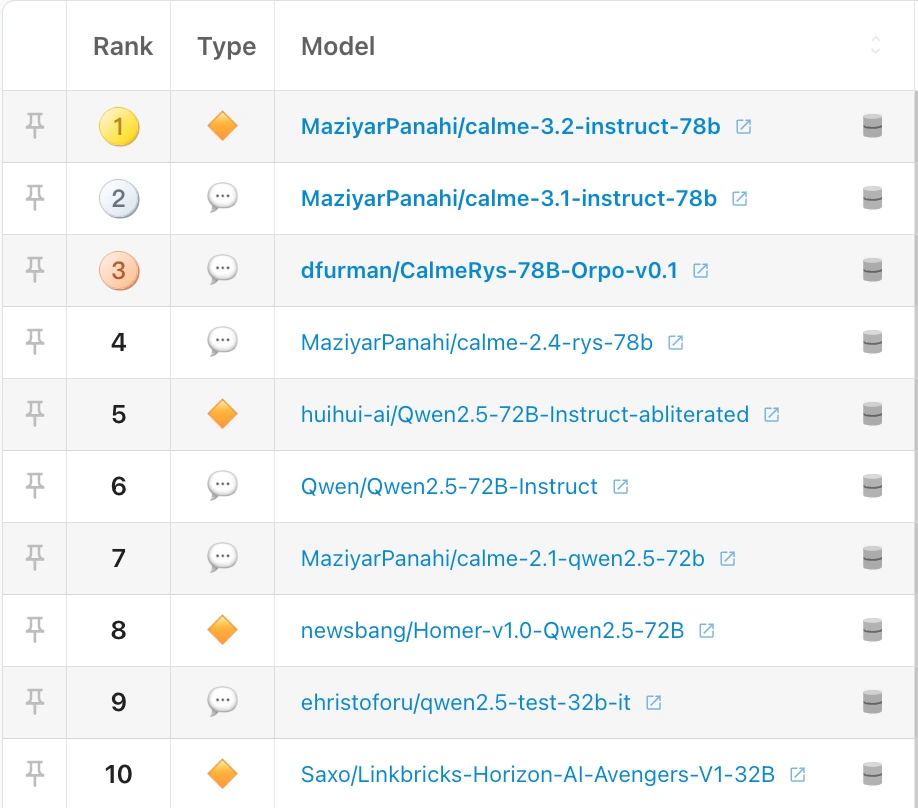
If you broaden your perspective globally, you can refer to the Hugging Face Open LLM Leaderboard. This is the most widely recognized benchmark for open-source weight models globally. It focuses on evaluating mathematical reasoning, common sense question answering, and coding abilities.
The top ten open-source models on the leaderboard are as follows. Among them, the top-ranked calme-3.2-instruct-78b was fine-tuned and merged by developer Maziyar Panahi based on Alibaba's Qwen2.5-72B model.
Details and Download Links for Common Open-Source Models
1. DeepSeek-V3.2/V3/R1
Features: King of logical reasoning. Common versions: 671B (V3 main model), R1 distilled version (7B, 14B, 32B, 70B, etc.).
Download link: https://canopywave.com/models/deepseek-v32
2. Qwen 3
Features: All-rounder, strongest adaptability. Common versions: 0.5B to 72B, 32B is widely considered a "masterpiece" balancing performance and memory usage.
Download link: https://canopywave.com/models/qwen3-coder-30b-a3b
3. GLM-4
Features: Extremely stable long-text (128K) processing, smooth multilingual switching, and a very powerful visual understanding version (4V). Common versions: GLM-4-9B, GLM-4V-9B, AutoGLM-Phone-9B (mobile).
Download link: https://canopywave.com/models/glm-46
4. Llama 3.1 / 3.2
Features: Richest global ecosystem. Common versions: 1B, 3B (mobile); 8B, 70B (mainstream inference); 405B (top-tier computing).
Download link: https://huggingface.co/meta-llama
5. Special Recommendation: MaziyarPanahi Series (A boon for local deployment)
Introduction: Ranked first globally on the Open LLM Leaderboard. Value: Smaller memory footprint, faster speed.
Download link: https://huggingface.co/MaziyarPanahi